The role of carbon labelling in tackling climate change
Authors: Paul Smith, Carbon Footprinting and Labelling Project Leader, LRQA. Graham Meller, Buttonwood Marketing.
Summary
A new report on carbon labelling has concluded that consumers want reliable, trustworthy information that will help them to make decisions which benefit the environment. They also want to be able to trust retailers and their suppliers in making some of those decisions for them.
The report, entitled ‘Check-out Carbon’, was produced by Forum for the Future and sponsored by Lloyd’s Register. It summarises the findings of a research project designed to explore the role that carbon labelling has to play in delivering a low-carbon shopping basket.
The report highlights the importance of opportunities that exist to reduce carbon emissions as a result of consumer purchasing and in light of the urgency required to prevent climate change, report author Dan Crossley says, “Carbon labelling is a vitally important tool in helping to reduce carbon in the shopping basket but it is clear that prioritisation is required; we need to deal with the big (carbon) impacts first and not rush headlong into labelling everything.”
The research included a brief survey of 1,000 consumers which revealed that 85 per cent of respondents want more information about the environmental impacts of products.
The report was launched at the London headquarters of Lloyd’s Register, an event that attracted some of the UK’s top sustainability and climate change experts. Contributing panellists included Peter Madden, CEO of Forum for the Future, Euan Murray, Carbon Footprinting General Manager of the Carbon Trust, Terence Ilott, Head Environment, Business and Consumers Division, of DEFRA, Katherine Symonds, Sustainability Manager of Tesco and Ian Hodgskinson, MD of Lloyd’s Register Quality Assurance (LRQA), who chaired the event.
Commenting on the reasoning behind LRQA’s support at the launch, Ian Hodgskinson, said, “The report highlights the fact that carbon labelling information needs to be available, easy to understand and trustworthy in order for consumers to make the right choices. Lloyd’s Register is a global, truly independent organisation that focuses on building trust through the implementation of management systems such as ISO 14001 and EMAS. We help organisations to improve their green credentials and create brand recognition with customers and stakeholders through transparency and verification. It is logical therefore, for us to be intimately involved in carbon footprinting and labelling initiatives.”
Background
In order to have a chance of stabilising the earth’s temperature at 2 degrees Celsius above pre-industrial times and avoiding dangerous climate change, global greenhouse gas emissions need to be at least halved by 2050. This means that emissions must start to decline within the next 10 – 15 years – a tiny window of opportunity.
There are many well-documented contributors to global warming such as gas guzzling cars, flights, inefficient use of electricity, inadequate thermal insulation, heating and waste disposal. However, what is perhaps less well known is the fact that the products that consumers buy and use account for almost half of the average consumer’s carbon emissions. Therefore, any initiatives that help to deliver a low carbon shopping basket are to be welcomed.
Millions of buying decisions are already made every day that reflect concerns about climate change. Tesco, for example, says that two thirds of its customers understand what a carbon footprint is and that 80% of them say they think about the environmental impact of what they buy.
The challenge is to capitalise on such evident willingness to create a low carbon shopping basket – with sufficient speed and rigour.
‘Check-out Carbon’
In conducting its research, Forum for the Future interviewed industry experts, and commissioned ICM to conduct focus group discussions with consumers and to survey 1000 adults in the UK. The results showed that when it comes to tackling climate change, consumers want clear information from reliable and trustworthy sources. They also want suppliers and retailers to make choices for them – that is to ‘choice edit’ their supplies, by removing from their shelves those products that consumers would find environmentally unacceptable.
The report proposes key steps for government, manufacturers, suppliers and retailers to achieve a low-carbon shopping basket:
- Encourage consumers to make the big, non-product choices – such as driving less.
- Provide advice and support action on the product issues that really matter – such as reducing food waste and using electrical appliances more efficiently.
- Take sustainability decisions on behalf of customers – remove the high-carbon villains from sale (choice editing).
- Ensure carbon messaging fits with other sustainability messaging – don’t confuse consumers or send mixed messages.
- Give advice on how to reduce post-checkout impacts – when product use or disposal impacts are significant.
- Start with the big feet – prioritise measurement and labelling of products by focusing on those with: high overall footprints; high impacts during consumer use; high variability within a category; high volume; and big opportunities for reduction.
- Be selective about what you communicate – don’t put a label on everything.
- Ensure you give consumers options, not just information – know what your consumers want to do with a label.
Ian Hodgskinson added, “It is clear from the research and from discussion at the event that whilst carbon labelling has an important role to play, it is an issue that should be approached with care. Procedures for the evaluation of a carbon footprint should be standardised, data should only be provided by independent trustworthy organisations, carbon footprinting should be prioritised and data transfer to consumers must be undertaken in an effective, consistent manner.”
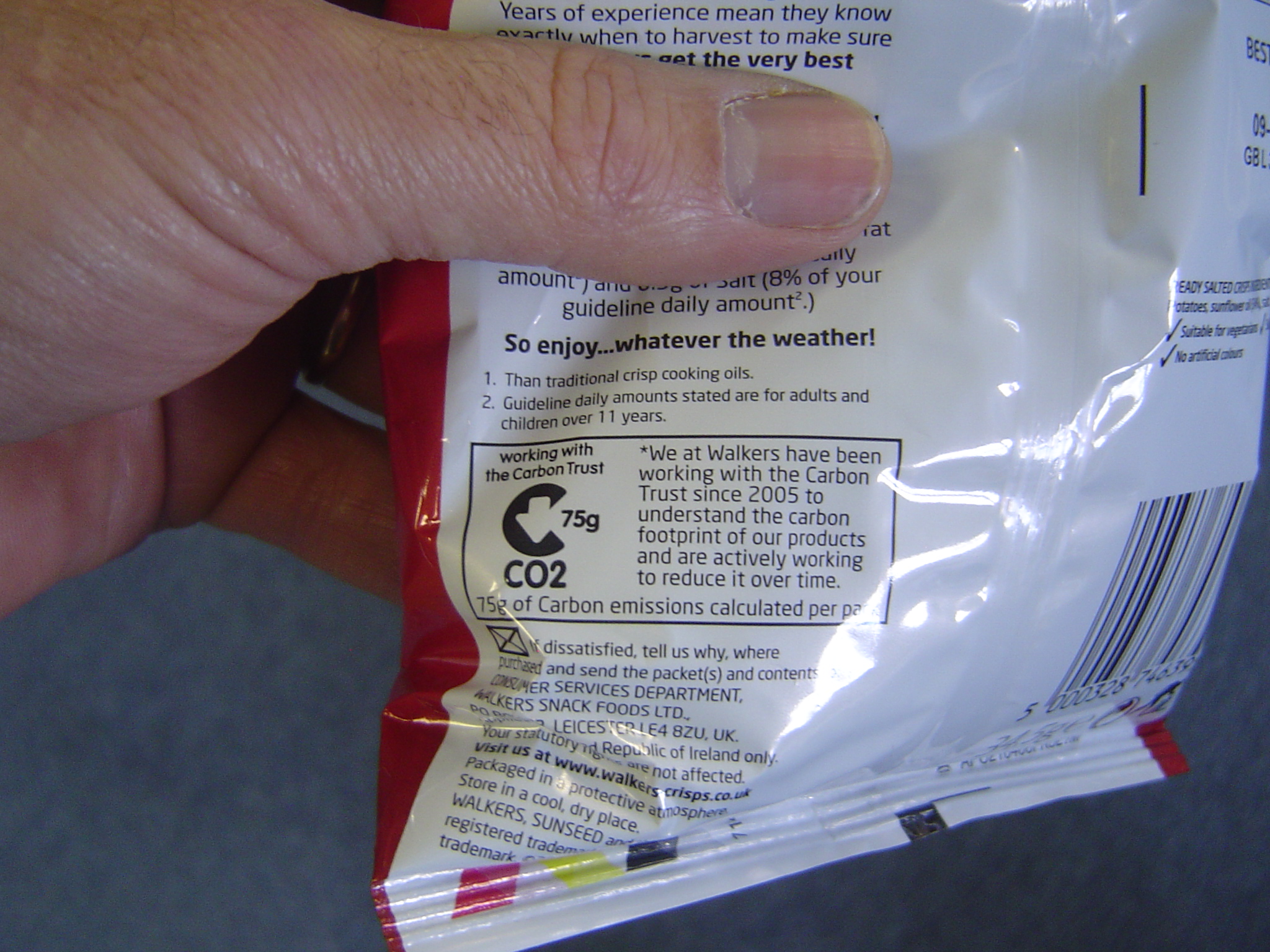
A small number of manufacturers and retailers have started work on carbon labelling, such as Tesco and PepsiCo (with its Walkers crisps brand), but definitive guidance is not yet available on what information a label should contain and how it should appear. The report concludes that label information should be simple, distinctive and come from a trusted source.
Euan Murray welcomed the report saying, “At the moment there is insufficient data available on carbon footprinting, so we don’t yet really know what is good and what is unacceptable, so a great deal more work has yet to be done.”
Commenting on the challenge of how to communicate carbon messages to consumers, Katherine Symonds said, “Tesco is experimenting with labelling and has produced a booklet which gives examples of the carbon costs of different activities, such as a family day out, so that consumers can put carbon label information into perspective.” She added, “We are committed to getting these labels on our products in a way that’s informative and accessible, combining information with tips on reducing impact and comparisons with other products. As consumer carbon literacy increases, we will be able to go further.” She also emphasised the likely effects of carbon labelling on supply lines, stating, “If a product’s sales drop as a result of its poor carbon performance, the impact will force the supply chain to look for ways of improvement.” Concluding, she said, “By carbon labelling its first twenty products, Tesco has taken the first few steps on an exciting journey and we are learning more with every day that the labels have been on display.”
Terence Ilott expressed his gratification with the level of interest in carbon footprinting, adding, “Carbon footprint methodology is not just a labelling tool; it enables businesses to evaluate their supply chains even if labelling is not the objective. We expect businesses to choice edit their supplies both in terms of carbon footprint and sustainability as a whole.”
Conclusions
The over-riding message arising from the report and from the discussions at the launch event, was that consumers want ‘trust’ – they want to be able to trust retailers not to supply products that harm the environment (two thirds of consumers wanting government and business to phase out products that are environmentally damaging) and they want trustworthy information so that they can make valid choices.
Many consumers are either not interested or are too busy to make rapid decisions on hundreds of products, preferring instead to give their business to retailers whom they trust to make decisions for them.
Whilst carbon labelling every product is not a realistic or indeed desirable goal, if addressed in a strategic, prioritised manner it represents a powerful tool in the fight to reduce the 45 per cent of an average consumer’s carbon emissions that are attributable to the things they buy and use.
Ends
Words 1,362
Notes to editors:
1. The contact details are as follows:
Alex Briggs
Marketing Communications Manager
LRQA Centre
Lloyd’s Register Quality Assurance Ltd.
Hiramford, Middlemarch Office Village
Siskin Drive
Coventry CV3 4FJ
England
T +44 (0) 24 7688 2382
F +44 (0) 24 7630 6055
2. Useful links:
‘Check-out carbon’ report: http://www.forumforthefuture.org/
Video of report authors Dan Crossley and Tom Berry: http://www.veoh.com/videos/v146608144zXK8JxR
Carbon labelling Blogs and Podcasts: http://businessassurance.com/carbonlabelling/
Video of Peter Madden, CEO of Forum for the Future, speaking about carbon labelling:
http://www.forumforthefuture.org/node/4640 or
http://www.youtube.com/watch?v=7JJJ0_xJ8QY – Carbon Labelling Report Launch – Video Summary
3. About Forum for the Future
Forum for the Future – the sustainable development charity – works in partnership with leading organisations in business and the public sector. Our vision is of business and communities thriving in a future that is environmentally sustainable and socially just. We believe that a sustainable future can be achieved, that it is the only way business and communities will prosper, but that we need bold action now to make it happen. We play our part by inspiring and challenging organisations with positive visions of a sustainable future; finding innovative, practical ways to help realise those visions; training leaders to bring about change; and sharing success through our communications.
www.forumforthefuture.org.uk
Registered charity number: 1040519
4. About Lloyd’s Register
Lloyd’s Register is an independent risk management organisation that works to help improve its clients’ quality, safety, environmental and business performance throughout the world, because life matters.
Lloyd’s Register stands apart: independent, objective, experienced and uncompromising in our commitment to help clients produce an overall positive impact on society and the environment.
www.lr.org
Registered charity number: 21567 R
Posted by Buttonwood Marketing – Technical Scientific Environmental Sustainability PR and Marketing Communications Experts