A group of Arctic researchers has employed the latest monitoring technology to investigate the effects of climate change, by measuring temperature and salinity in the water column beneath surface ice. The results of the investigation, which utilised YSI’s new ‘Castaway-CTD’, could cast new light on our understanding of the ways in which shifting ocean currents impact upon the climate in northern Europe.
The Catlin Arctic Survey is a unique collaboration between scientists and explorers, and the Castaway enabled the researchers to work very quickly in extremely hostile conditions because the device is small, portable and can be operated in the field without the aid of a computer.
Previous research looked at ice thickness and ocean acidification, but the latest Catlin Survey work has studied freshwater currents beneath the ice surface to help understand their effect on bottom-up ice melting, which is disrupting global ocean circulation.
Background
It is well established that the Arctic environment has a significant effect upon the global climate. For many years, climate scientists have raised concerns over future shifts in global weather systems and highlighted the role that the Arctic plays in such systems. Changes in the Arctic heavily contribute to the Thermohaline Circulation; a giant aquatic conveyor connecting the planet’s oceans, distributing heat, oxygen and nutrients. Changes to the Thermohaline Circulation combined with vast atmospheric, positive feedback loops (that produce large quantities of methane from the melting permafrost) that occur within the Arctic, can have drastic repercussions on the global climate.
In 2011 the Catlin Arctic Survey was commissioned by The Catlin Group to assess the temporary ice base on the Prince Gustav Adolf Sea, on the northern most fringe of Canada’s Arctic archipelago, around 800 miles from the North Pole.
Organic Matter
A key measurement parameter for the team was Coloured Dissolved Organic Matter (CDOM), because high levels can result in 40% higher light absorption. In the Arctic, much of the CDOM is derived from three of Northern Russia’s vast river mouths. Commenting on the significance of CDOM, Dr Victoria Hill, a British-born Oceanographer, said: “Locally CDOM should act to increase thermal stratification, trapping heat near the surface. The water becomes more stable and there is reduced mixing. However, if surface ice melts, it creates an upper layer of fresh, cold water which does not mix. In the long run, the surface water becomes warmer and no longer sinks to form the deep and colder water that draws the Gulf Stream to Northern Europe.”
The researchers anticipated that the Arctic Ocean would be highly transparent, because the rivers contributing CDOM were frozen. However, the team determined that this was not the case. In fact, Dr. Hill revealed: “In the Chukchi, between 70 and 80% of solar radiation was being absorbed by CDOM.” In another data set, retrieved by Adrian McCullum, from the Scott Polar Research institute, concerning results were obtained from a sample of the water column; at a depth below 200m, the water was 1 Deg C colder than expected. This significant change in normally stable, deep water, suggests that the surface melt water was sinking, driving warmer water into contact with the surface ice. This sparked further interest into the variation of temperature in the Arctic Ocean.
Arctic Ocean profiling
Highly specialised equipment is necessary for profiling very deep water. However, YSI’s Castaway CTD has been developed to provide a simple and accurate method for the rapid determination of conductivity, temperature and depth down to 100 meters. Incorporating GPS, sensors, data logging and a display into one compact instrument, the device is literally cast (or lowered) into water and retrieved immediately. The Castaway automatically collects and computes the data and users are able to see the result of their work immediately on a small display. The investigation in to CDOM’s effect on ocean temperatures was therefore an ideal application for YSI’s Castaway-CTD (conductivity, temperature and depth). A light-weight and easy to use hydrographic profiling instrument, with high-resolution sampling of conductivity, temperature and depth, the Castaway was a vital piece of sampling equipment used by the Catlin Arctic Survey team.
Castaway CTD – user feedback
Ann Daniels, of the Catlin Expedition Team was keen to stress the importance of the CTD to the success of the survey, “It was very lightweight, perfect for a long-range scientific expedition. The LCD display was very useful as it allowed the team to view information from the CTD while in the field, and allowed ‘live science’ to be relayed back to HQ by phone. It meant there was interest generated during the expedition rather than having to wait till the unit was returned to the UK.”
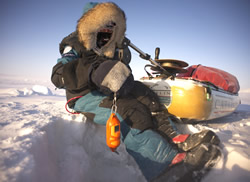
Easily deployed, the Castaway was cast into bore holes created in the Arctic ice, and allowed to free –fall at depths of up to 100 metres, its sensors gathering data, including a temperature system able to respond within 200 milliseconds. The device was especially well designed for surveys in this extreme environment. A rugged, non-corrosive housing, a flow-through design, AA battery power and tool-free operation meant Castaway was perfectly suited for an Arctic survey.
Commenting on the value of the Castaway to the survey team, Science Programme Manager Dr. Tim Cullingford, said: “The Castaway CTD was deployed by the explorer team for the Catlin Arctic Survey 2011 during March to May. The conditions at this time of year in the Arctic are extreme, with temperatures down to -40DegC. Nevertheless, the Castaway was successfully deployed through holes drilled in the ice to an ocean depth of 100 meters. Its compact nature meant that it was easy to handle (e.g. keeping it warm just before deployment was simply done by placing inside the explorer’s jacket). The screen allowed an immediate return of temperature and salinity readings, which were successfully relayed back to London HQ on a regular basis. In the round, the Castaway provided an easy and useful back-up to the data returned by our main CTD.”
Maintenance of the Castaway is very simple; a quick rinse with fresh water and the occasional scrubbing of the corrosion-resistant electrodes is all that is required to keep the Castaway-CTD in shape between recommended annual factory calibrations.
Warm water application
Recently, the Castaway-CTD was employed in a similar manner on BBC 1’s Ocean Giants narrated by Stephen Fry. The first episode in a 3-part series investigated why Blue Whales, usually a migratory species, stay around the Sri Lankan coastline in the warmer waters. Marine biologist Asha de Vos wanted to study the features of this water that sustain these whales year round, using the Castaway to record salinity and temperature levels at differing depths she concluded: “Along our coastline, there are areas of mass upwelling of cold, nutrient rich water from the depths. These upwellings provide the perfect conditions for whale food; krill.”
Whilst Castaway retains all the advantages of a traditional CTD system, its additional appeal lies with its convenience, flexibility and speed – whether the instrument is being used in the freezing waters of the Arctic or the warm tropical waters of Sri Lanka.
Ends
Words: 1,176